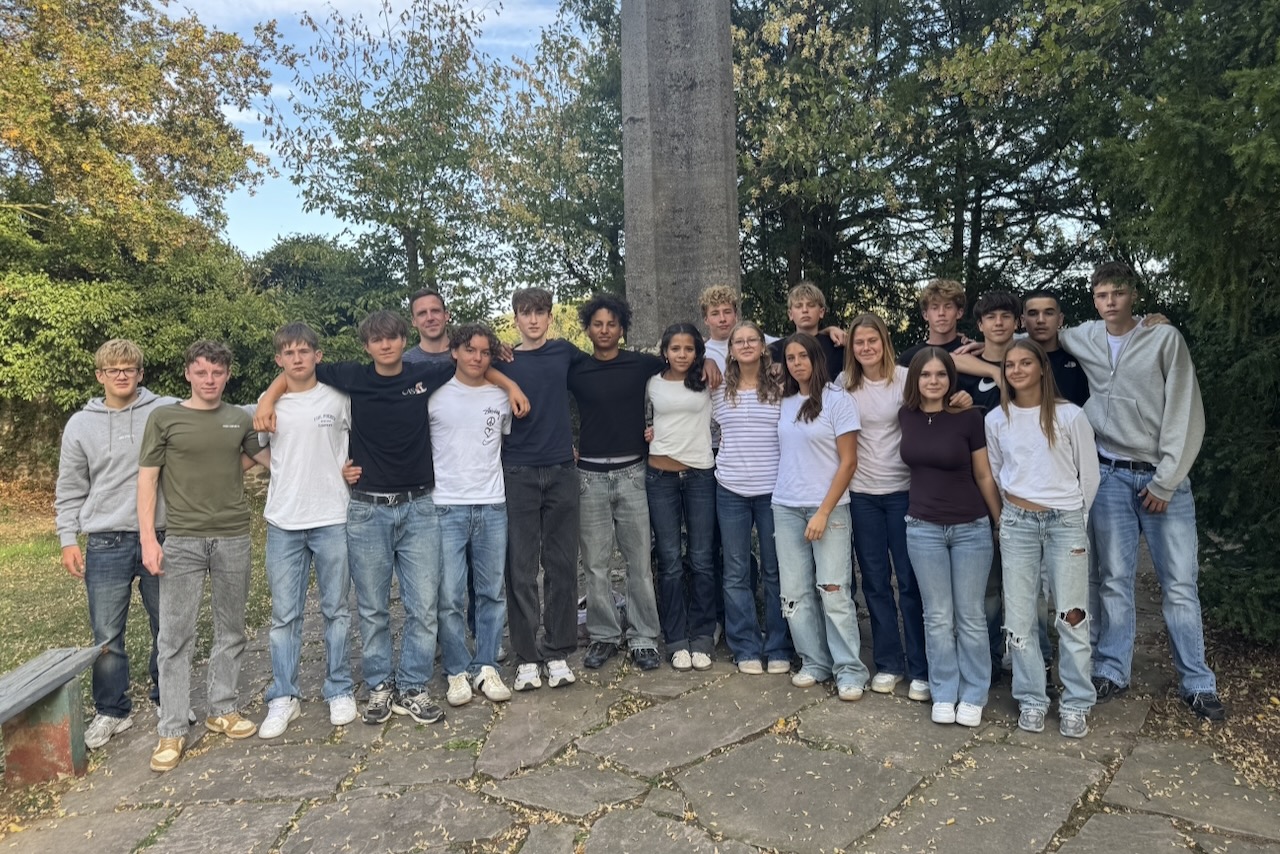
After 10f’s field trip to Hadamar with their history teacher Mr. Ringler on September 30, 2026, we started our English lesson with a simple question:
How was it yesterday?
A lot of students raised their hands and almost everybody had to say something important. They began to reflect thoughtfully on their guided tour at Hadamar Memorial – what they have learnt, felt and why remembering this place is still important today.
It meant a lot to the young students to share their impressions and thoughts. Read what they wrote at home. It shows the impact this field trip had on every single student:
Ch. Welz
Sophia F.:
In Hadamar, during the time of National Socialism, nearly 15,000 people with disabilities or mental illness were murdered.
The Nazis called it „euthanasia“, meaning “good death“. In reality it was murder. We wanted to understand how this could happen and what it means to us today.
During a guided tour, we saw the former gas chamber, the crematorium and the exhibition about the victims. We heard stories of individual people: how they lived, who their families were. That touched me, because the victims were not numbers, but human beings like you and me.
What was important and new for me: It was not only about history. It was about the question of what a human life is worth. New for me was that doctors, nurses and people from the town participated or looked away.
In our discussion afterwards, we talked about: Who decides which life is “worth living”? And what does that have to do with exclusion and bullying today?
Sara M.:
This was a really shocking and memorable experience because it probably has never occurred to most of the students how large the number of deaths in these euthanasia camps was.
Richard, our guide, led us to the basement where we could take a look at the gas chambers. You could see the gas pipes and a resemblance with showers, because the people were told they would take a quick shower, from which they would never return because instead of water it was gas that filled that room, leading to the deaths of many innocent people. In the basement, you could also see the oven where the corpses were burnt.
I think it’s important that especially young people visit places like these to be informed about history and the suffering of so many innocent people. It’s important that people know that things like these really happened and that the systematic murder and torment – only because people were different or just didn’t agree with the regime were seen as less worth and no „use“ for society – must never happen again.
Milos I.:
We went into the courtyard. Richard showed us a big garage where the “ill people“ arrived. The buses had covered windows so no one could see what really happened. The garage was connected with a tunnel so the people could be brought into the building as secretly as possible.
There were also rooms that were there to steal valuable things like golden teeth, for example. I felt very sad and uncomfortable because I knew that many people were killed in that place.
We learned that also very young people were killed and that the families only heard lies, e.g. that their daughter died because of heart problems – which was a lie. We also learned that families couldn’t visit their loved ones, which is really cruel.
For more information see: https://www.gedenkstaette-hadamar.de/en/